

The Pentagon Just Admitted It Needs Nerds, Not Soldiers
A 12-month paid pathway into federal cybersecurity, with clearance and certifications built in — open to civilians with no experience and no degree.

I’ve been writing about the military’s cyber problem for literally years now. Not the fun stuff — not the cyber breaches that make the evening news — but the slow, grinding, bureaucratic reality underneath it.
The United States does not have enough people to defend its own networks, and we have known this for a long time.

I’ve watched it move through Congress one provision at a time. I’ve read the workforce strategies, the hiring-authority tweaks, the vacancy numbers that improve only to backslide. The through-line never changes.
Demand for cyber defenders keeps outrunning the supply of people cleared and trained to do the work.
So when I tell you the Cyber Registered Apprenticeship Program is real and not a recruiting gimmick, I’m not just spitting game. My boyfriend isn’t even a recruiter and he would be a terrible one if he was…he’ll say the same, I promise. I’ve been watching this need build for years, and this is the government finally doing something somehow sensible about it.
That’s why I care, and it’s why I want to make sure the people who’d actually benefit don’t scroll past it assuming it isn’t for them.
Because I know what all my fellow mid-30s millennials are thinking.
“I’m too late. The people in those high-paying ‘clearance’ jobs either went military at 18 or were coding before they could drive.”
For a long time, that wasn’t entirely wrong.
Why the military actually needs you (and isn’t just dressing up recruiting)
Start with the biggest misconception, because it’s the one that makes people dismiss this out of hand.
This is not “join the Army.” It’s a federal civilian job.
The Department’s cyber workforce is roughly 225,000 people, split across three groups — uniformed military, contractors, and civilian federal employees. That third group is enormous, and it’s where this apprenticeship lives. Civilians don’t deploy, don’t go to basic training, and don’t do pushups at dawn. They’re analysts, engineers, incident responders, and infrastructure specialists who handle the day-to-day defense of military networks — the same way a civilian engineer at NASA isn’t an astronaut. You’d be a federal employee with a paycheck, a clearance, and a desk — NOT a recruit.
This is the military finally saying, out loud, that the qualities that make a great cyber operator have nothing to do with passing an infantry fitness test. GEN (Ret.) Keith Alexander, the man who stood up U.S. Cyber Command, likes to tell a story about how skeptics in government dismissed his cyber teams as “a fat guy sitting on a bed typing.” He went on record saying those teams, “did things that everybody said was impossible.”
The military has wrestled with this since at least 2015, when the Army’s head of recruiting openly questioned whether cyber soldiers should have to meet the same height-and-weight standards as everyone else.
The reason they’re opening the door to civilians comes down to simple math.
The Department has spent years trying to close cyber vacancy rates that ran north of 25%, clawing them down toward 15%, only by leaning on special direct-hire authorities and adding tens of thousands of civilians. Congress keeps reinforcing the point.
The FY2026 defense authorization bill expands the Cyber Excepted Service and raises pay authorities specifically to compete for cyber talent. Meanwhile, a separate 2025 bill orders the Pentagon to deliver Congress a comprehensive plan for fixing its persistent cyber workforce gaps.
So if you’re unfamiliar with the structure of the military and how civilians work in the DoD — I just want you to understand that this isn’t a trick. They’re not going to force you to sign a 6-year contract if you apply. This new program is the result of an institution with a genuine staffing crisis deciding that the old hiring pipeline is too slow and too narrow to fix it.
So they’re building a wider door on purpose.
Why the old door was so hard to open
Security-cleared cyber roles have long favored people who took very specific paths — military service, the right degree from the right school, an early-career government internship, or a network that could get them in front of a hiring manager. Everyone else — especially career-changers — got the same message in different packaging. You’re interested, but you’re not who we’re hiring.
If you’ve ever tried to break in, you’ve hit the classic catch-22:
The interesting (let’s be honest…high-paying) roles require at least a Secret clearance, often higher.
Clearances are sponsored by an employer who has already hired you. You quite literally cannot secure a government clearance without a sponsor willing to pay for it.
Employers prefer candidates who are already cleared because it’s faster and cheaper.
It’s the same trap as needing credit history to get your first credit card. So you do the right things — take courses, earn a cert or two, fix friends’ networks, build a home lab, apply to job after job — and still get filtered out because you can’t check the clearance box.
Cyber RAP changes that math. Run by the Office of the Chief Information Officer at the U.S. Department of Defense, and it’s built for people who don’t have a clearance yet. The eligibility bar is that you’re “able to obtain and maintain a government security clearance,” not that you already hold one.
What the apprenticeship actually is
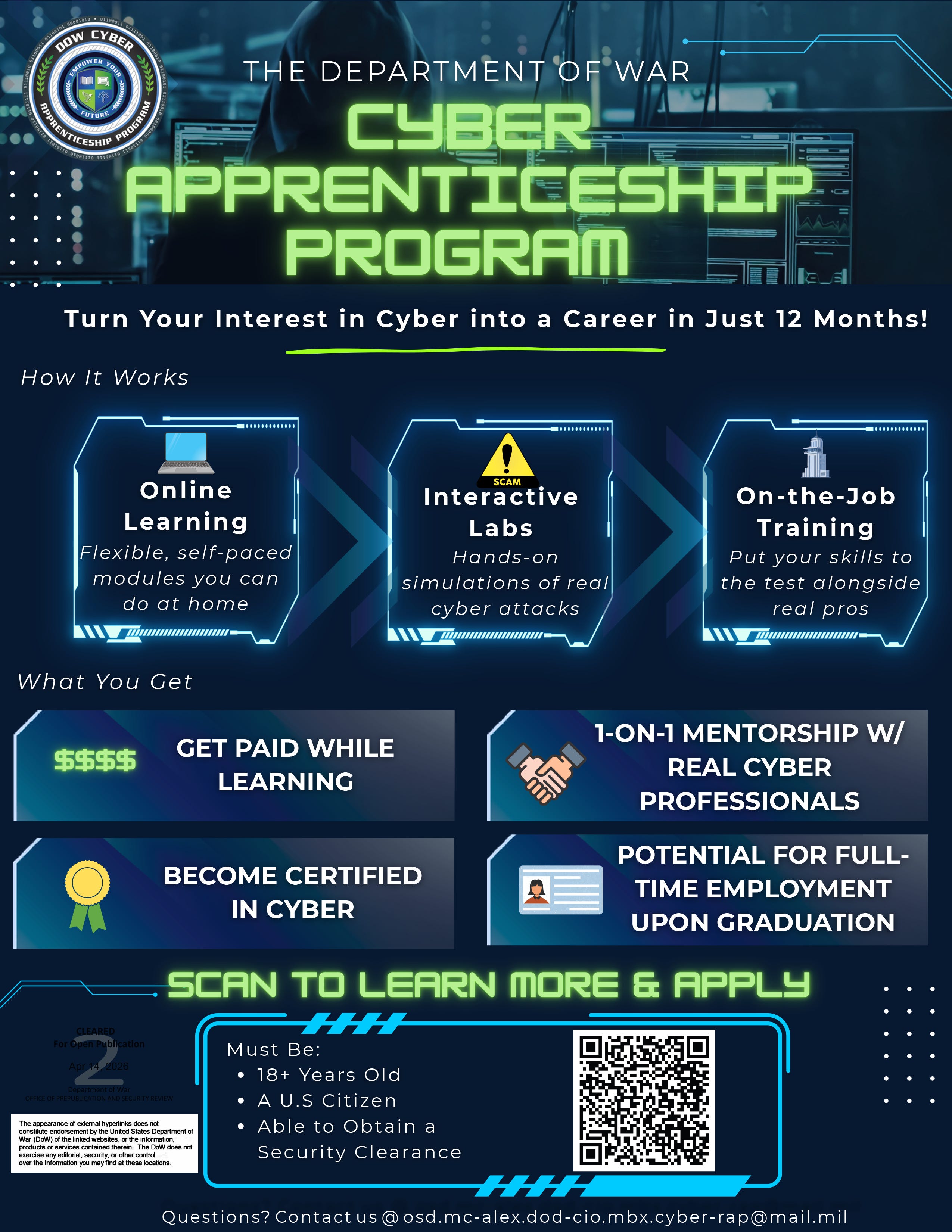
At its core, Cyber RAP is a 12-month, paid “earn while you learn” program inside the Department, launching as a pilot in this summer.
It’s a structured, competency-based sequence that blends:
Online learning — asynchronous modules you work through on a schedule
Interactive labs that simulate real attacks and defenses
Mentorship from senior Department cyber professionals
On-the-job training inside actual federal cyber environments
The curriculum maps to formal federal cyber work roles under the DoD/DoW 8140 framework — Cyber Defense Analyst, Cyber Defense Infrastructure Support Specialist, and Cyber Defense Incident Responder — not vague “IT generalist” slots. When you finish, you can point to specific roles you’re qualified for instead of a fuzzy “I learned some security stuff.”
You also graduate with industry-recognized certifications and the option to keep going toward a cyber degree through the DoW Cyber Service Academy.
You do NOT need a clearance to apply, but the Department doesn’t advertise guaranteed sponsorship either. What it requires is that you’re able to obtain one.
In practice, a federal cyber role and the clearance process are the destination you’re working toward — and you have to be clearable to get in the door.
“But I’m in my 30s. Isn’t this for 22-year-olds?”
No. This program exists precisely because the traditional pipeline can’t keep up. The Department says it’s “aggressively shifting away from a ‘degree first’ mindset” toward skills-based, day-one readiness.
And officially, no prior experience is required to apply.
People in their 30s and 40s bring things a 22-year-old usually can’t:
Real work history and references
A track record of showing up, following through, and handling adult life
The ability to put risk, policy, and mission in context
A clearance investigation is, at its core, a trust exercise. It weighs the pattern of your life, not whether you took Intro to Cybersecurity before dropping out of Community College. If your history is stable and you’re honest about the bumps, age isn’t a disqualifier. Actually — very often — it’s an asset.
So if you’ve been telling yourself you missed your window, that’s a story you were handed. It was never a rule.
Who this is realistically for (and who it isn’t)
This is for you if:
You’re a U.S. citizen, 18 or older, and can reasonably pass a background investigation.
You’ve done something technical — help desk, network support, scripting, systems administration, a home lab, a bootcamp, a cert. (Not required, but it helps you hit the ground running.)
You’re willing to treat this like a trade — 12 focused months to build a career that can carry you for decades.
This is probably not for you if:
You want a fast, low-effort route to a six-figure salary.
You wince at the ideas of structure, process, and rules — clearances come with all three.
You’re hoping to hide a serious, ongoing problem from the investigation. Honesty isn’t optional here. You will go to prison.
If you’re somewhere in the middle — “I’ve made mistakes, but I’ve cleaned things up and I’m playing it straight now” — you’re exactly the person who should take a closer look.
What’s actually in it for you
When people hear “apprenticeship,” they picture low pay and a dead end. This one works differently.
Paid, structured training for a full year. You’re not draining your savings on an endless stack of courses — you’re getting paid to learn.
Real experience in environments few civilians ever touch, alongside professionals whose full-time job is defending national-level systems.
A path toward a clearance. Cleared cyber work shrinks your competition dramatically. Once you’re cleared and experienced, you’re fishing in a much smaller pond.
Long-term earning power. Entry-level pay won’t make you rich overnight, but cleared cyber work has a ceiling well above many traditional IT roles, and it rises as you take on more advanced positions and higher clearance levels. Congress has even moved to raise the federal pay ceilings for these roles specifically.
Direct placement. The program is designed to convert successful apprentices into permanent federal cyber positions on completion.
You’re not doing this for a year to see what happens. You’re doing it to change where your career is headed.
How to actually apply
There’s no rolling application portal yet. (YET…keep reading you’re almost there, I promise.) Hiring runs through the federal system on a posting-by-posting basis.
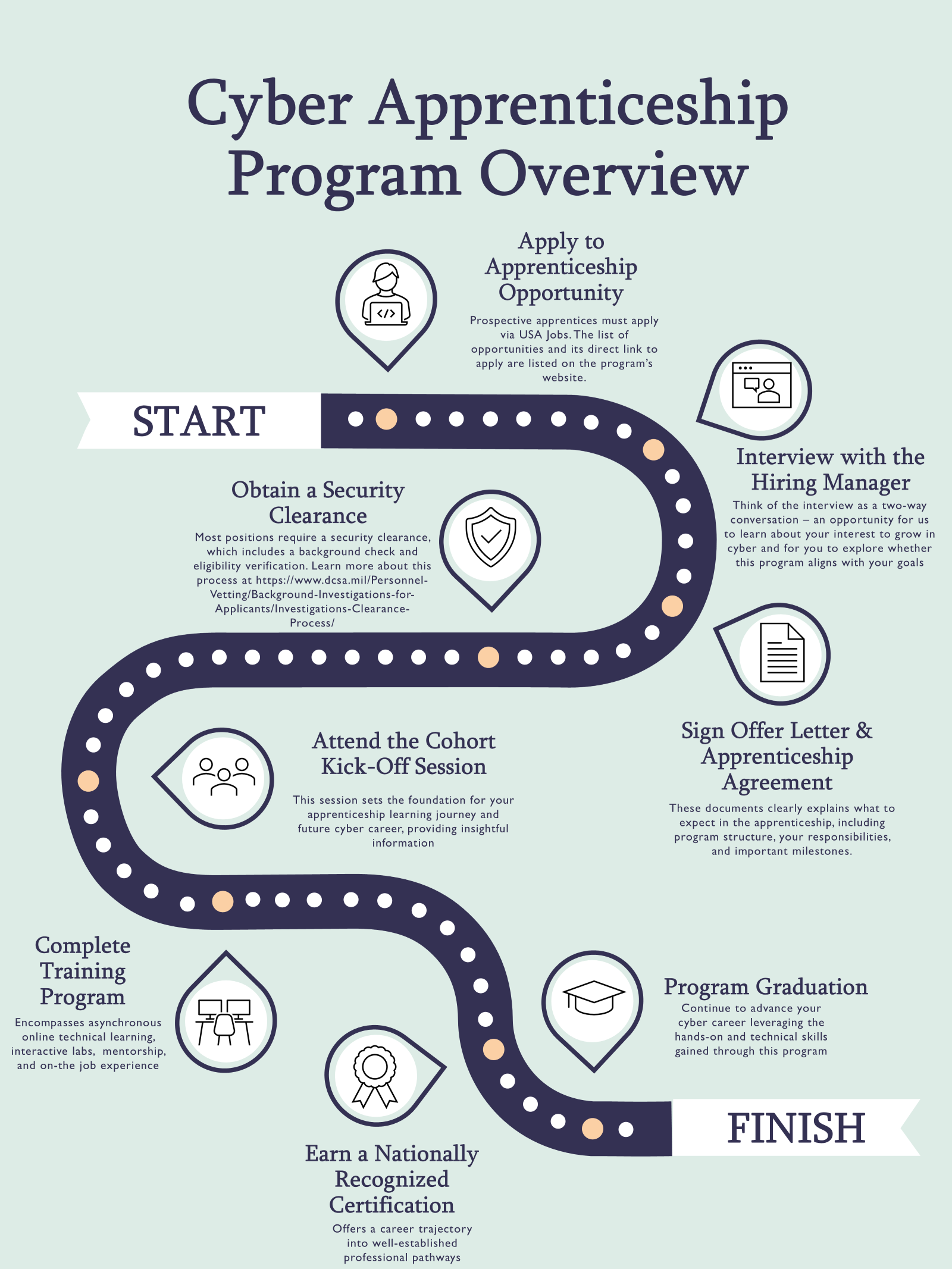
Watch USAJobs. Participating Department agencies post apprenticeship openings on USAJobs, and you apply through those announcements.
Get on the mailing list. The program office is taking names for launch notifications at osd.mc-alex.dod-cio.mbx.cyber-rap@mail.mil. Applications are expected to open in June 2026, with the pilot starting that summer. (Email that long ass inbox name — and get on the list. Please.)
Know the timeline. This launched at the Department of Labor’s National Apprenticeship Week signing ceremony on April 28, 2026, as a pilot — meaning early cohorts are limited. Getting on the list early is worth the two minutes.
If you’re curious but skeptical, start here
If this is hitting a nerve but your inner skeptic is yelling “too good to be true,” — that’s fair and I understand you’re hesitance. You don’t have to decide today, but you can get ready to move when you do by doing a little prep-work.
Audit your tech skill set. Write down everything you’ve actually done — home labs, scripts, small networks, tickets closed, systems supported. You’re probably more “technical” than you give yourself credit for.
Get your life admin in order. Clearances care about patterns — unpaid debt, unresolved legal issues, undisclosed foreign contacts. Start tackling what you can. Small, consistent progress counts.
Treat this as a career pivot, not a side quest. If you go after it, go all in. Read up on cyber defense. Learn the basic tools. Get comfortable with logging, monitoring, and networking fundamentals. The apprenticeship is an on-ramp — you still have to drive. (Let me know if you need resources. I will help.)
The bigger picture
Even if you never apply, programs like this signal a real shift in how federal cyber talent gets built:
Away from degree-only gatekeeping
Toward skills-based, experience-driven pipelines
With a federal cyber role — and the clearance process that comes with it — as the destination, not a prerequisite
For people in their 30s who’ve spent years feeling like the door was welded shut, this is a rare moment where the system is actually trying to meet you halfway.
If you’ve ever thought, “If someone just gave me a real shot, I’d show them what I can do” — this is what that shot looks like.
Bet on yourself.
Get your name on that email list.
I believe in you.